What is Pandas

Table of Contents 1. Introduction: What is Pandas?Pandas is a powerful Python library for working with structured financial data. It provides intuitive data structures—like Series (for single columns of data) and DataFrames (for full tables)—that make it easy to clean, analyze, and transform datasets such as price histories, income statements, trading...
Continue reading

Capital Expenditures (CAPEX)/Depreciation

Capital Expenditures (CAPEX)/Depreciation

What are capital expenditures? Capital expenditures are amounts spent to acquire tangible assets that will be used for more than one year in the operations of a business.  Examples are plant, machinery, equipment, computer software.  These amounts are “capitalized” to the balance sheet as assets and through the income statement over...

Continue reading

Working Capital

What is working capital? The high level definition of working capital is simply: current assets minus current liabilities.  The three most common working capital items are accounts receivable (asset), inventory (asset) and accounts payable (liability).  These are balance sheet accounts that the company needs to run its business.  For example, receivables...

Continue reading

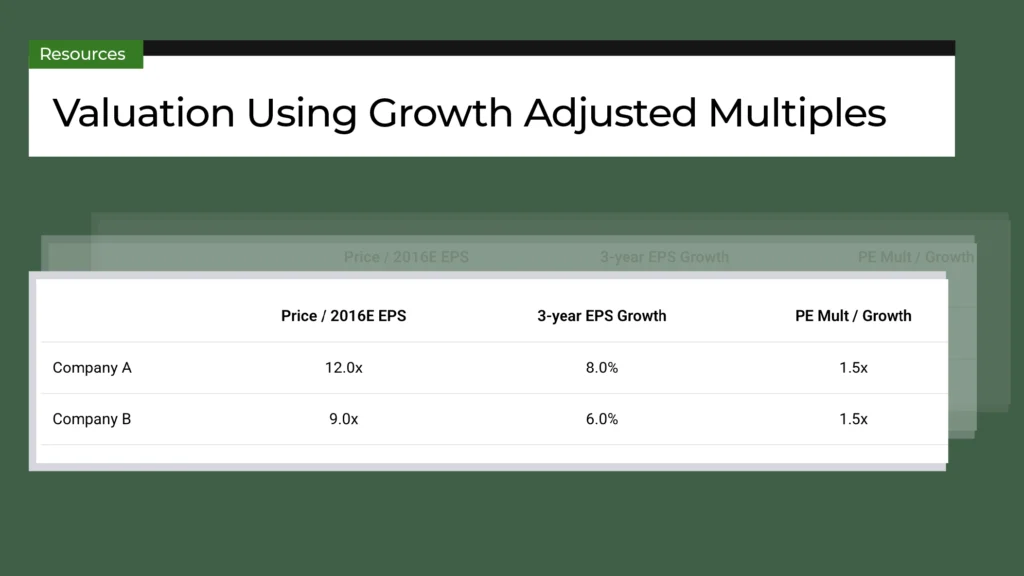
Valuation Using Growth Adjusted Multiples

Valuation Using Growth Adjusted Multiples Using comparable trading multiples is a common way to value a company or an asset. In an efficient market, it makes sense that investors should be willing to pay roughly the same amount (per dollar of cash flow or earnings, etc.) for two similar companies. But...

Continue reading

Long-term Investment (LTI) & Equity Method Investment

What is a Long-term Investment (or “LTI”)? There are different items that could be classified as a long-term investment.  A parent company may have a small ownership stake in another company (i.e. there may be a strategic reason to have an ownership position in a key supplier).  Note – this must...

Continue reading

Income Tax

What does the Income Tax Expense line on the income statement mean? All companies calculate their income taxes using two sets of rules:   Accounting Rules (IFRS or US GAAP, depending on where the company is based)   Tax Rules (these are set by each country’s government tax agency) The Income Tax Expense line...

Continue reading

Equity Value

In this article, we’ll explore the topic of Equity Value, basic and diluted shares outstanding, and key ratios related to equity value. Table of Contents How do you calculate equity value? What are basic shares outstanding? What are fully diluted shares outstanding? When do we use Equity Values in ratios? What are some problems with Equity...

Continue reading

Earnings per share (EPS)

Earnings Per Share (EPS) is one of the most widely used metrics in financial analysis—and for good reason. It represents the portion of a company’s profit allocated to each outstanding share of common stock, making it a key indicator of profitability and shareholder value. Whether you're a seasoned investor, a...

Continue reading

What is Enterprise Value?

What is meant by Enterprise Value? A simple way to think about enterprise value is that it represents the market value of all the assets of the firm, regardless of how they are funded.  In contrast, equity value refers to only the common equity holders’ residual stake in the value of...

Continue reading

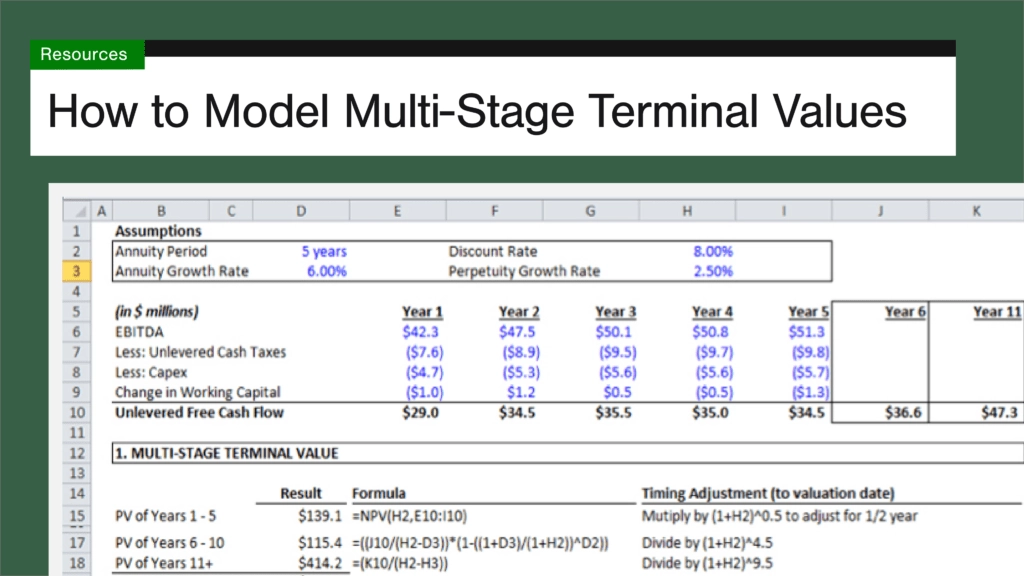
How to Model Multi-Stage Terminal Values

How to Model Multi-Stage Terminal Values As James Bond theme-song singer Shirley Bassey once crooned, "Cash Flows are forever, they are all I need to please me.... I've no fear that they might desert me". Ok, maybe not quite. For those who use Discounted Cash Flow ("DCF") for valuation, you have probably...

Continue reading