
Excel Formula Basics: How to Build Them Correctly From the Start
Most Excel errors in financial models don’t come from complex functions. They come from basic formula construction habits that were never corrected early on. Manually typed cell references, hardcoded values buried in calculations, formulas that are needlessly long. These are fixable problems, but only if you know what good practice looks like before the bad habits set in.
An Excel formula is any cell entry that begins with an equals sign. From there, the range of what’s possible is enormous, but the underlying discipline is the same whether you’re building a simple subtraction or a multi-layered model: keep it clean, keep it traceable, and never type what you can click.
The Rule That Matters Most
Never manually type a cell reference into a formula. This means don’t type C3 when you could click on cell C3. It sounds like a minor distinction. It isn’t.
Typed references are prone to errors that are hard to catch. You might type C13 when you meant C3, and if both cells contain plausible numbers, the formula won’t throw an error. It will just return the wrong answer. In a model with hundreds of interconnected formulas, that kind of mistake can propagate silently for a long time.
Clicking or navigating to a cell with the arrow keys is slower by a fraction of a second and faster in every other way. It’s accurate, it highlights the cell you’re referencing so you can confirm it visually, and it’s the standard that every professional model-builder uses.
The underlying issue is that Excel’s default hyperlink behavior treats cell addresses as fixed coordinates, not as references that update dynamically. The solution is to give Excel something more stable to point to.
How to Create an Excel Formula: Step by Step
The example below builds a simple subtraction formula. The same process applies to any arithmetic operation, and the habit of clicking rather than typing carries into every function you’ll use in more advanced work.
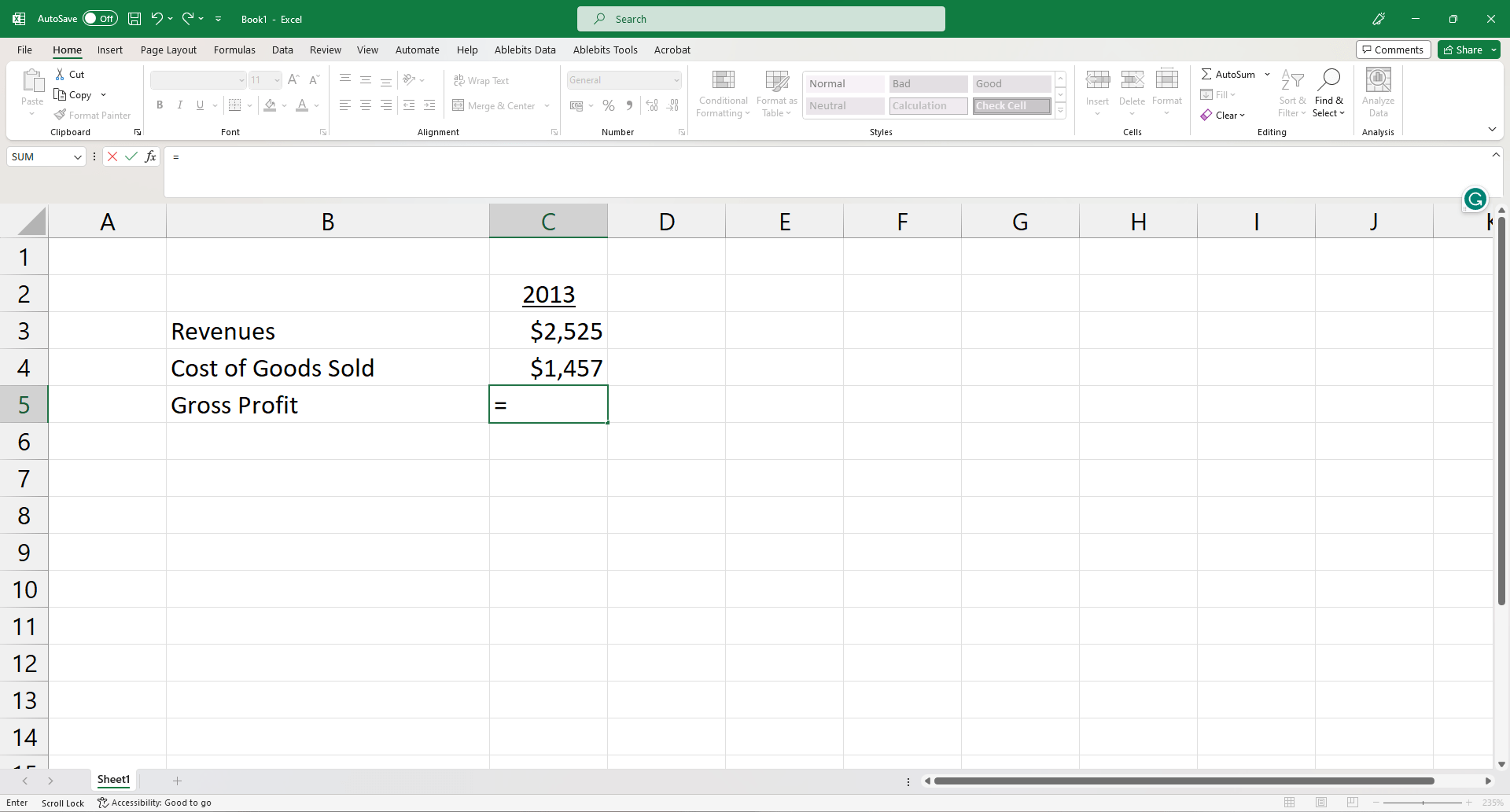
Step 1: Type the equals sign
Click into the cell where you want the result to appear and type =. This tells Excel that what follows is a formula, not a text entry or a number. Nothing will happen yet on screen beyond the cursor activating in the cell.
The example below builds a simple subtraction formula. The same process applies to any arithmetic operation, and the habit of clicking rather than typing carries into every function you’ll use in more advanced work.
Step 1: Type the equals sign
Click into the cell where you want the result to appear and type =. This tells Excel that what follows is a formula, not a text entry or a number. Nothing will happen yet on screen beyond the cursor activating in the cell.
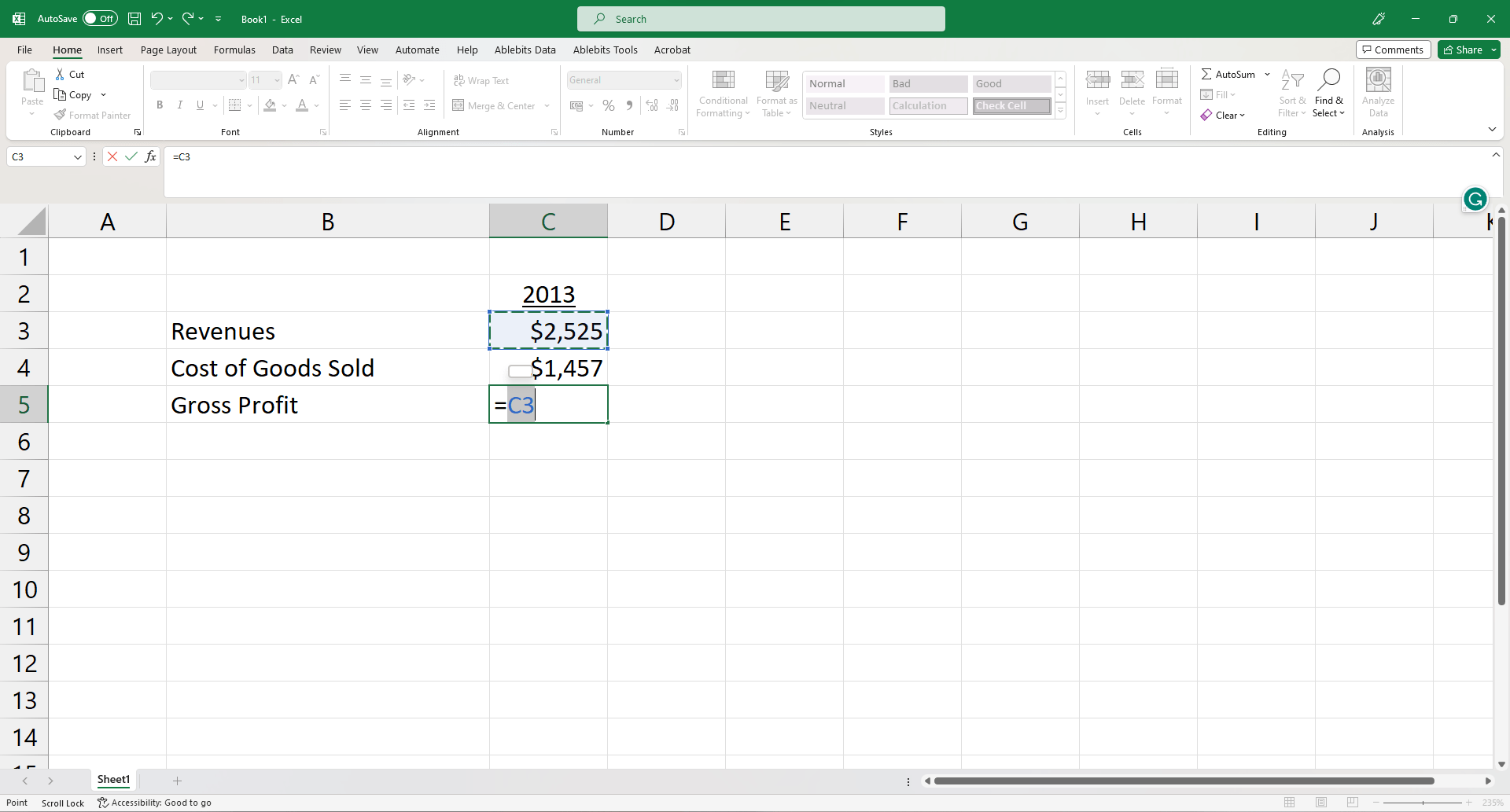
Step 2: Select the first cell
Click on the first cell you want to reference, or navigate there using the arrow keys. Excel will highlight that cell and populate its address into your formula automatically. You’ll see the reference appear in both the cell and the formula bar.
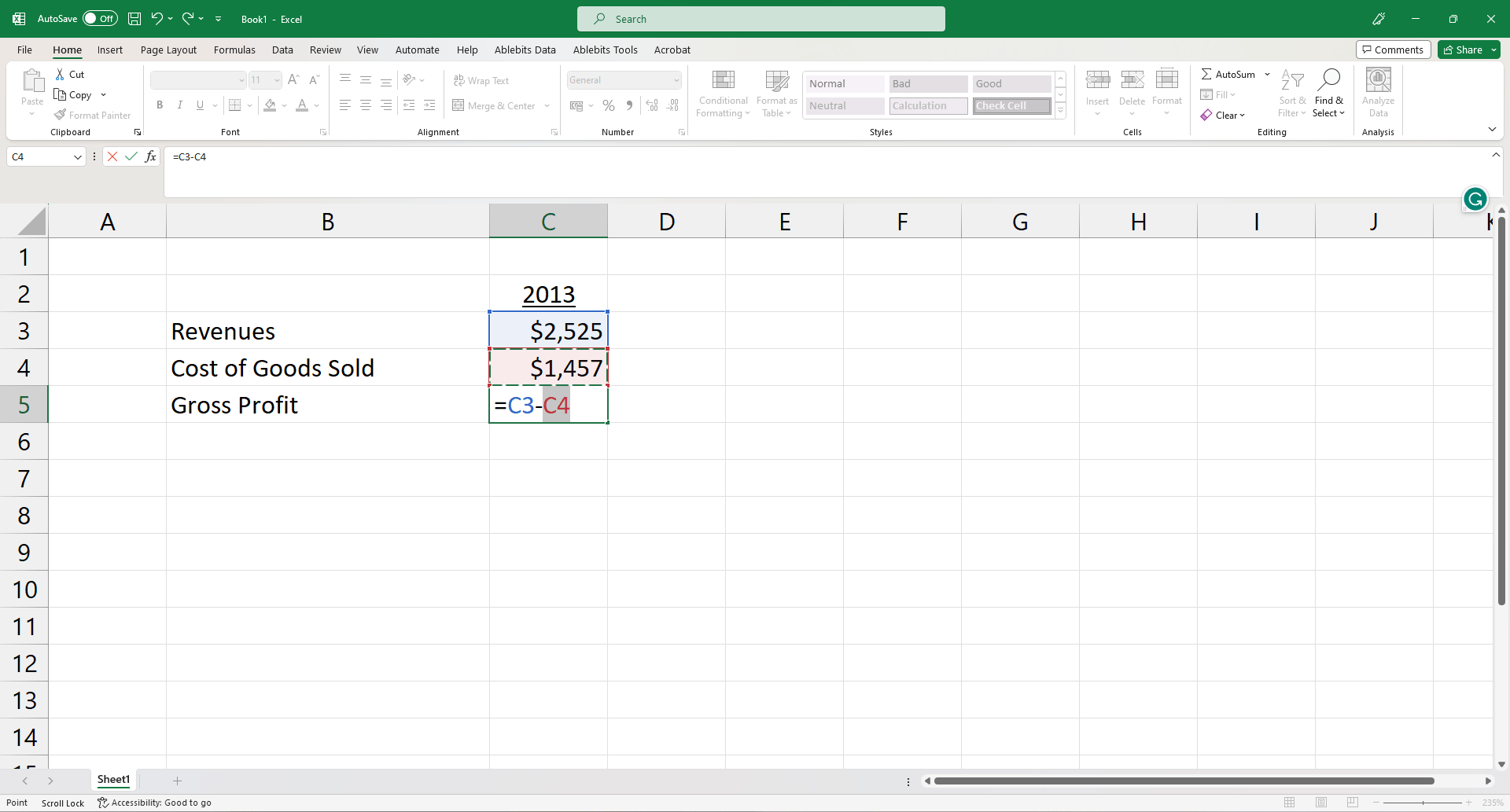
Step 3: Type the operator
Enter the arithmetic operator for the calculation. For subtraction, type -. For other operations, use +, *, or /. At this point the formula reads something like =C3- and Excel is waiting for the next input.

Step 4: Select the second cell
Click on or navigate to the second cell. Again, Excel fills in the reference for you. The formula bar now shows the complete expression.
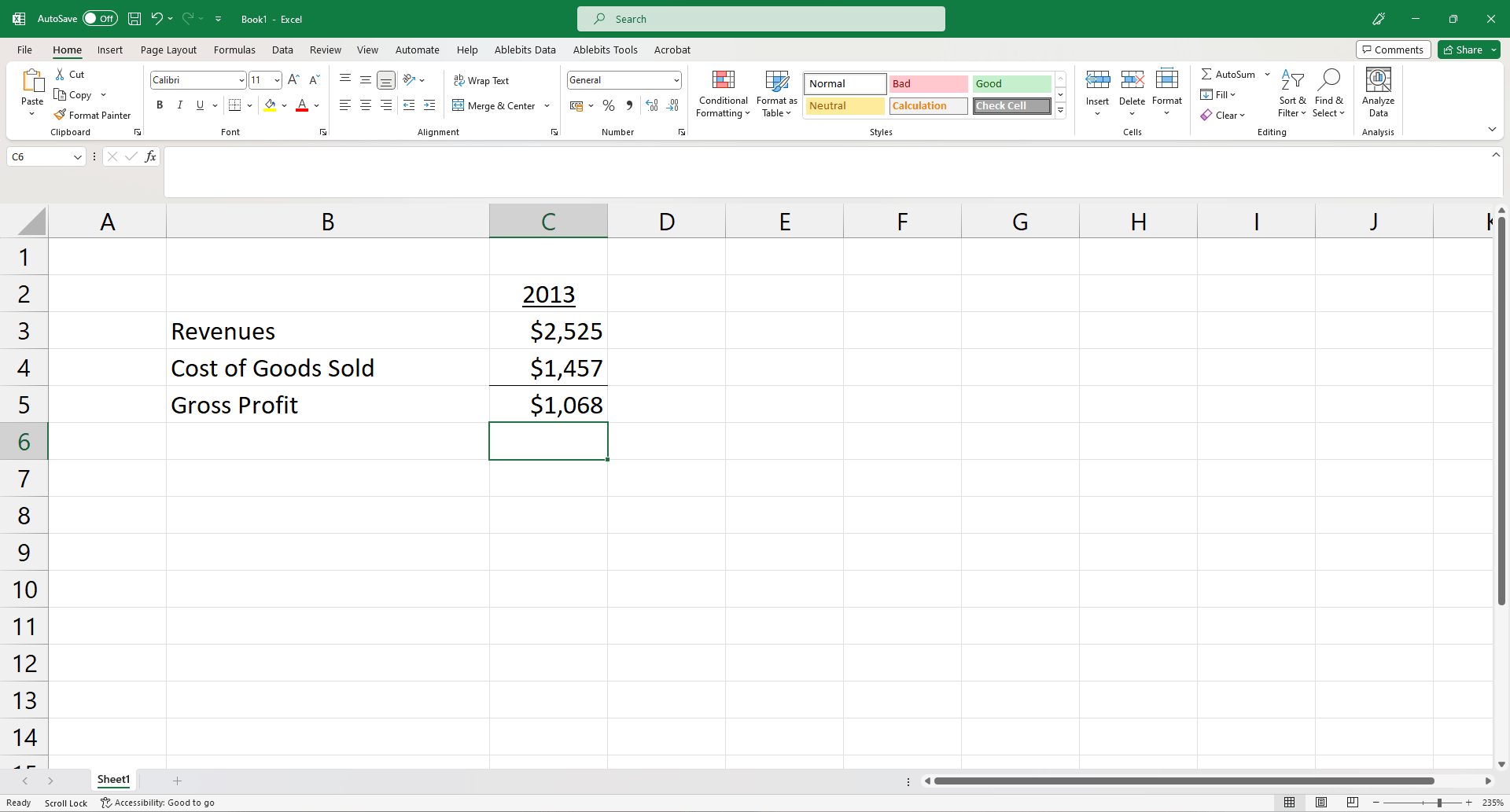
Step 5: Press Enter
Press Enter to confirm the formula. Excel calculates the result and displays it in the cell. The formula itself remains visible in the formula bar whenever that cell is selected.
Operators and Order of Operations
Excel follows standard mathematical order of operations. Exponents calculate first, then multiplication and division (left to right), then addition and subtraction (left to right). Parentheses override this order, so use them whenever the sequence of calculation needs to be explicit.
In a formula like =C3+C4*C5, Excel will multiply C4 by C5 before adding C3. If you intended to add C3 and C4 first, you need =(C3+C4)*C5. The difference matters, and in a financial model where outputs feed into other calculations, an incorrect order of operations can be difficult to trace.
| Operator | Function | Example |
|---|---|---|
+ | Addition | =C3+C4 |
- | Subtraction | =C3-C4 |
* | Multiplication | =C3*C4 |
/ | Division | =C3/C4 |
^ | Exponent | =C3^2 |
( ) | Override order of operations | =(C3+C4)*C5 |
Formula Best Practices for Financial Models
The step-by-step above gets you started. The habits below are what separate a workable spreadsheet from a model someone else can actually review and trust.
Keep formulas as simple as possible. A formula that runs across three lines of nested functions is hard to audit and hard to fix when something breaks. If a calculation requires multiple steps, break it into intermediate rows. The extra space is worth it.
Never hardcode a number inside a formula. If your revenue growth assumption is 8%, that 8% should live in a clearly labeled input cell and be referenced by every formula that needs it. Burying *0.08 inside a calculation means that when the assumption changes, you have to find and update every formula rather than changing a single input.
Be consistent with how you structure formulas across the model. If one row subtracts costs from revenue, every row that does the same calculation should follow the same pattern. Inconsistency makes errors harder to spot and makes the model harder to hand off.
Use Ctrl+` (grave accent) to toggle between formula view and value view across the entire sheet. It’s a quick way to scan for anything that looks out of place, such as a hardcoded number where a formula should be.
If you want to take this further, these are the two courses worth looking at.
Applied Excel
Become a Master in Excel for Finance
Advanced formula construction, model architecture, shortcuts, data manipulation, and modeling pitfalls. Covers the structural discipline that keeps complex models navigable under pressure.
Mastering Excel Bundle
Self-Paced Excel Training for Finance
Works from Excel fundamentals through to advanced modeling technique. Built for analysts who want real fluency, not just familiarity with the basics.
Includes three modules